 (1 x 13 Speed) (Ultra-Torque)_1.webp)
 (1 x 13 Speed) (Ultra-Torque)_2.webp)
 (1 x 13 Speed) (Ultra-Torque)_3.webp)
Availability: 9 in stock
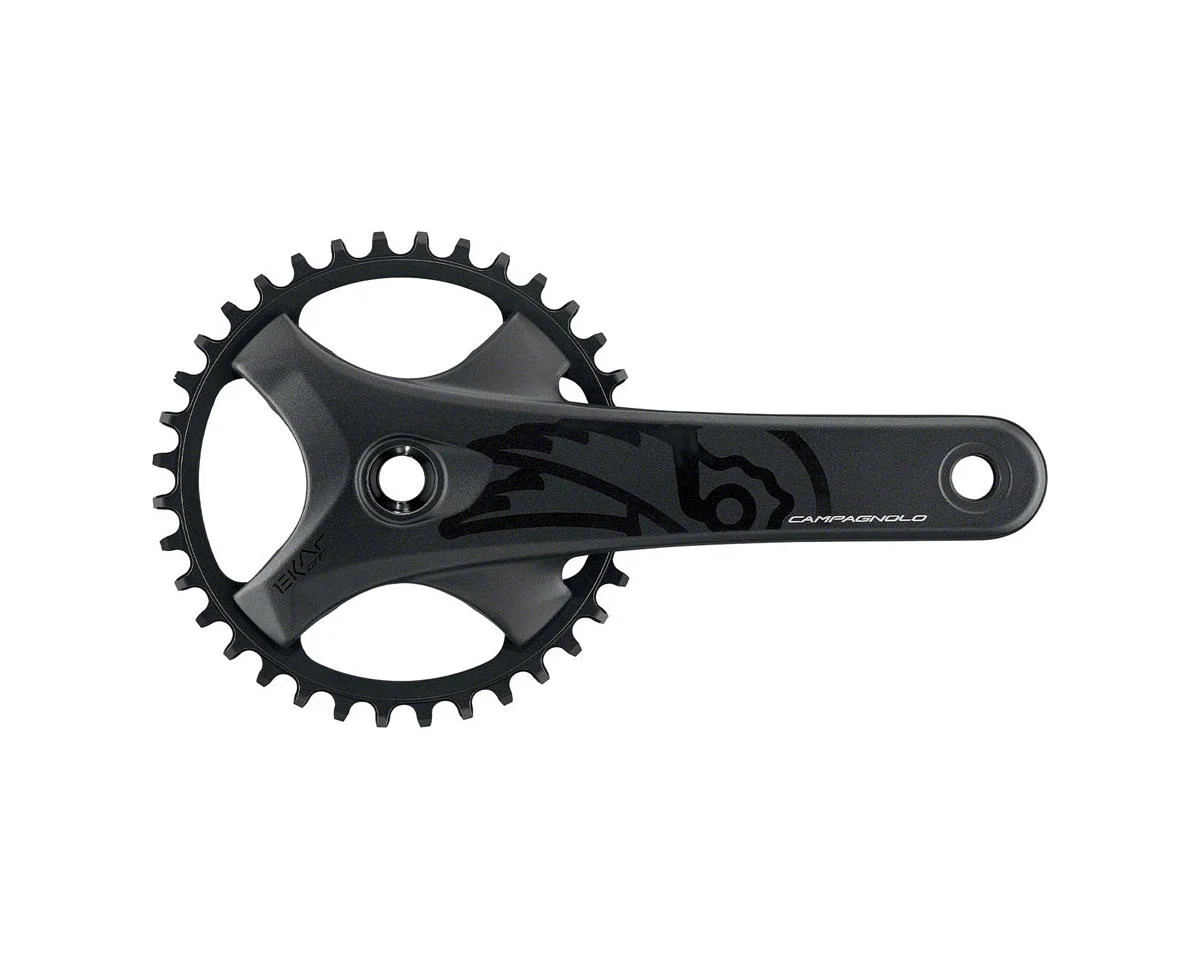
The Campagnolo EKAR GT Gravel Crankset is a 1×13-speed crankset that has been designed to maximize the performance of bicycle equipped with Campagnolo’s EKAR GT groupset. Aluminum crankarms are stiff and shrug off impacts from rocks and other trail obstacles, and are connected together using robust 25mm diameter AISI 630 steel Ultra-Torque semi-axles bonded to each crank arm, which are connected in the middle via a Hirth ProTech™ joint and a substantial steel bolt that not only has proven to be a stout system, this construction technique makes it much easier to inspect and maintain the stainless steel bearings/races. 7075 series aluminum alloy chainrings are optimized for use with a 13 speed EKAR/EKAR GT cassette and chain, and are bolted to the crankarms via a 4-bolt symmetrical 104BCD bolt pattern for excellent performance and an easier time sourcing replacement chainrings. The Q-Factor (distance from the center of the bike to the crankarm) makes it easier for a rider to get into a comfortable pedaling motion and provide clearance so these cranksets can be fitted onto a wide range of bike frame configurations, while the chainline offset of the chainrings results in excellent chain retention and shifting performance throughout the entire 13-speed cassette gear range. Plus, four different chainring sizes and three different crank arm lengths are available to dial in the bicycles gearing and the fitment of the crankset to many different leg lengths/proportions. Add all of these features together, and the result is a crankset that will provide plenty of ruggedness, bike and rider fitment, gearing flexibility, and a reasonable weight that makes them an easy addition to any gravel or adventure bicycle fitted with a 1×13-speed Campagnolo EKAR GT groupset.
Notes:Bottom bracket cups are not included with the crankset. Also, Campagnolo states that the minimum chainstay length (measured from center of bottom bracket spindle to center of rear hub axle) for these cranks is 410mm (approximately 16.14″); shorter chainstays on the frame will negatively affect chainline, shifting performance, and chain retention, as well as increasing the likelihood of the crankarms, chainring, and the riders foot coming into contact with the frame.
 (Direct Mount) (143mm Spindle w_CINCH Interface) (7050 Aluminum)_1.webp)
 (42T) (12_13 Speed) (DUB Wide) (E1)_1.webp)
_1.webp)
 (55mm Chainline) (170mm) (30T)_1.webp)